buy gold and silver bullion

Tuesday, May 5, 2020

Gold is a hedge against the government doing something stupid


Governments and central banks are throwing all the money they can into financial markets to support a flaying global economy rocked to its core from the COVID-19 pandemic. 

Although the world could see the worst downturn since the Great Depression of the 1930s, Axel Merk, chief investment officer and president of Merk Investments, warned investors: "there will be no free lunch." 

Merk said that he like gold as a hedge against these unprecedented measures and the growing risk that the government could make a misstep in financial markets and do something "stupid."

- Source, Kitco News

Friday, May 1, 2020

Economic Inflation and Deflation All At Once


The Covid carte blanche power grab. Covid excuse to spend trillions - (you get to pay it back). New cold war companions? Russia & China.

Wednesday, April 29, 2020

Economic damage from the coronavirus is hitting the lowest level of wage earners hardest


Plunges in employment, manufacturing and other widely followed data points only tell part of the story behind the coronavirus-induced economic damage. What they don't readily reflect is where the worst of it will fall, and that's likely to be on the people who can handle it least.

Lower-income groups, who depend on the service industry for jobs, are taking the biggest impact from the shutdown of an economy that is driven by services like hotels, bars and restaurants. They work in the hard-hit retail sector and are dependent on others being able to shop and dine and travel, activities which all have been sharply curtailed during the current shutdown.

While government programs have been focused on keeping people afloat who have been displaced by the efforts to curtail the coronavirus spread, the pain is likely to be long lasting.

"The largest body blows are to the travel industry, the retail industry, parts of the health care industry that are on the front lines battling the virus. Those are generally low-paying jobs, so the folks in the bottom part of the income wealth distribution are going to get creamed by this," said Mark Zandi, chief economist at Moody's Analytics. "There's no doubt about it."
'Deeply unequal' impacts

Economists at the St. Louis Federal Reserve have been tracking the impact from the current shutdown and see the biggest hit to the bottom fifth of earners.

In a paper released a few days ago, they projected final demand in food, leisure and hospitality to drop by 75%. In all, they project consumer spending to fall an average of 3% but consumption to slide by 5% in the bottom income rung. That tells some of the story about the consumer impact, but "perhaps more important, these consumption declines are deeply unequal — hitting those living in areas of highest financial distress the hardest," the economists said.

The situation is going to be exacerbated, the research found, because the initial spread of coronavirus cases happened in regions with lower levels of economic stress previously, but now is spreading to higher stress regions.

Consequently, when the economy starts to recover, the areas that benefit likely will be those driven by financial services, like New York, while the more hospitality and tourism focused regions could languish.

"Those other service industries just aren't going to participate, and that's one reason to expect that any kind of recovery will be very, very weak," Zandi said. "It's going to be a slog. We're going to get a bounce when businesses start to reopen, but on the other side of that I think we're in economic quicksand for a while."
The case for a 'V'

Indeed, there's overwhelming evidence that the U.S. is in its deepest trough since the Great Depression, and the biggest hit from the 26 million Americans who have filed for unemployment benefits has come to those working in hotels, bars and restaurants.

There's less consensus, though, on what the recovery will look like, with projections ranging from a U, V, W, or even a "Nike swoosh."

The worst-case outcome is that even if the government starts lifting restrictions, people still will be too afraid to resume their normal levels, and that in turn will steepen the recession.

But there's another scenario that seems at least plausible, where any meaningful resumption of activity will be seen as a positive and those who are suffering at the bottom end of the scale will get at least a boost if not a full-scale thrust back into a normal life.

"We're definitely going to have a 'V' off the bottom. To me, there's not much debate about that," said Jim Paulsen, chief investment strategist at the Leuthold Group. "When you go down as much as we've gone down, any bounce is going to feel like a 'V' initially. It may warp back into slower growth again fairly soon, but I think for a few quarters we have a 'V.'"

That bounce, he said, could be felt especially in hospitality businesses.

"If your restaurant is 100% shut down and by the end of the year, it's 50% shut down, that's still a heck of an increase," Paulsen said.
Changing views on the virus

The degree to which those businesses are brought back will depend on multiple factors. Containing the virus, obviously is critical. Also, the success of areas that have begun reopening, such as the state of Georgia and Las Vegas, also will be influential.

The past week brought some somewhat surprising news about the virus's progress.

New York Gov. Andrew Cuomo estimated that 14% of all state residents and 20% of New York City residents have been infected with Covid-19. Those numbers indicate two important things: that the disease is both far more widespread than previously thought as well as considerably less lethal, with New York mortality rates around 0.6% and hospitalization rates around 2%, according to Tom Lee, head of research at Fundstrat Global Advisors.

"A perspective -- imagine if policy makers knew hospitalization 2% and mortality 0.6% vs original belief of 20% and 5%-10%," Lee said in a note in which he said it's becoming clearer that treatment is most important for coronavirus cases, followed by testing and then by developing a vaccine.

"As a side note, it could have changed how policy makers would have reacted -- instead of shutting down the economy, the US might have only shut down NYC (for instance)," he wrote.

Lee said the 3% hit to consumer expenditures might not seem as daunting.

"In other words, once the economy is re-started, the 'hole' that will need to be filled by that potential 33% drop is $240 billion, which is not a deep a hole as one imagined a month ago," he said.

- Source, CNBC

Monday, April 27, 2020

Looking On The Other Side Of The Global Collapse

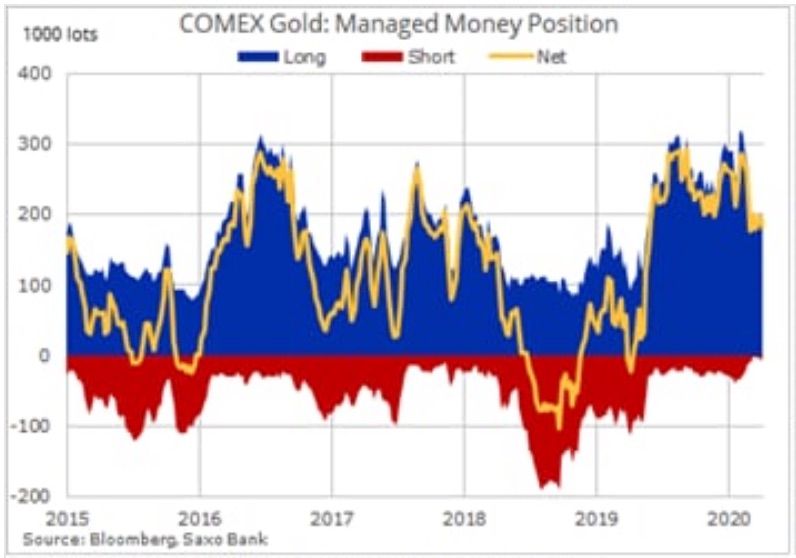
Ole Hansen, Head of Commodity Strategy at Saxo Bank: The gold net-long stayed within a 180k to 200k lots range for a fifth week with the oil price collapse and stronger dollar triggering a 10% reduction during the reporting week.

Gold Longs Remain Resilient, Despite Oil Price Collapse


The price briefly dipped to $1660/oz last Tuesday before finishing the week on a firmer footing. Having cut their longs by 36% from the February peak hedge funds seems to be looking for a sustained breakout before adding further length. Investors using bullion-backed ETF’s have however continued to accumulate longs with total holdings continuing to reach new highs.

Silver Update

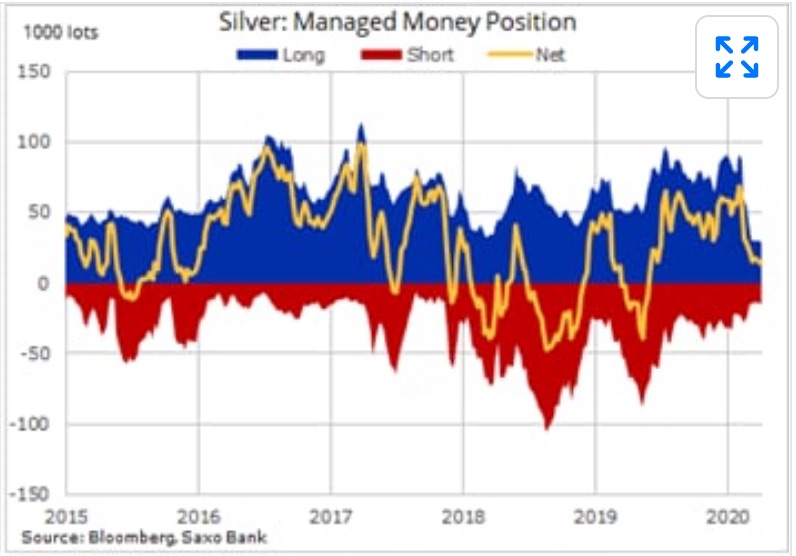
During the past two months silver has seen its net-long being cut by 80% to just 13.5k lots.

Silver Net-Long Positions Cut By 80%!


The combination of the global economic slump towards recession raising the risk of lower industrial demand and its often erratic trading behavior has sapped demand. It’s historical cheapness to gold and the risk of covid-19 related supply disruptions are currently two potential positives…

- Source, King World News, read more here

Sunday, April 26, 2020

Gold & Silver Price Update, Oil Market Volatility, Chaos Reigns Supreme


This week we review the price movements of gold and silver amid the current market conditions. 

As the economy sits on the brink, gold continues to climb getting closer to its all time highs. 

Will additional economic stimulus and radical moves from the Fed have an impact on the volatile equities markets?

Friday, April 24, 2020

There is Still Time to Jump into Gold Before the New Phase of its Bull Market


The gold market is on the cusp of a new phase in its bull market as central banks and governments around the world try to fight off a global depression, this according to Ronald-Peter Stoeferle, managing partner of Incrementum AG and author of the “In Gold We Trust Report”. 

Stoeferle said that gold prices have room to go higher; he noted that investors remain under-allocated in gold as inflationary risks continue to grow.

- Source, Kitco News

Thursday, April 23, 2020

Michael Oliver: We May See The Gold Market Go No Offer And Skyrocket

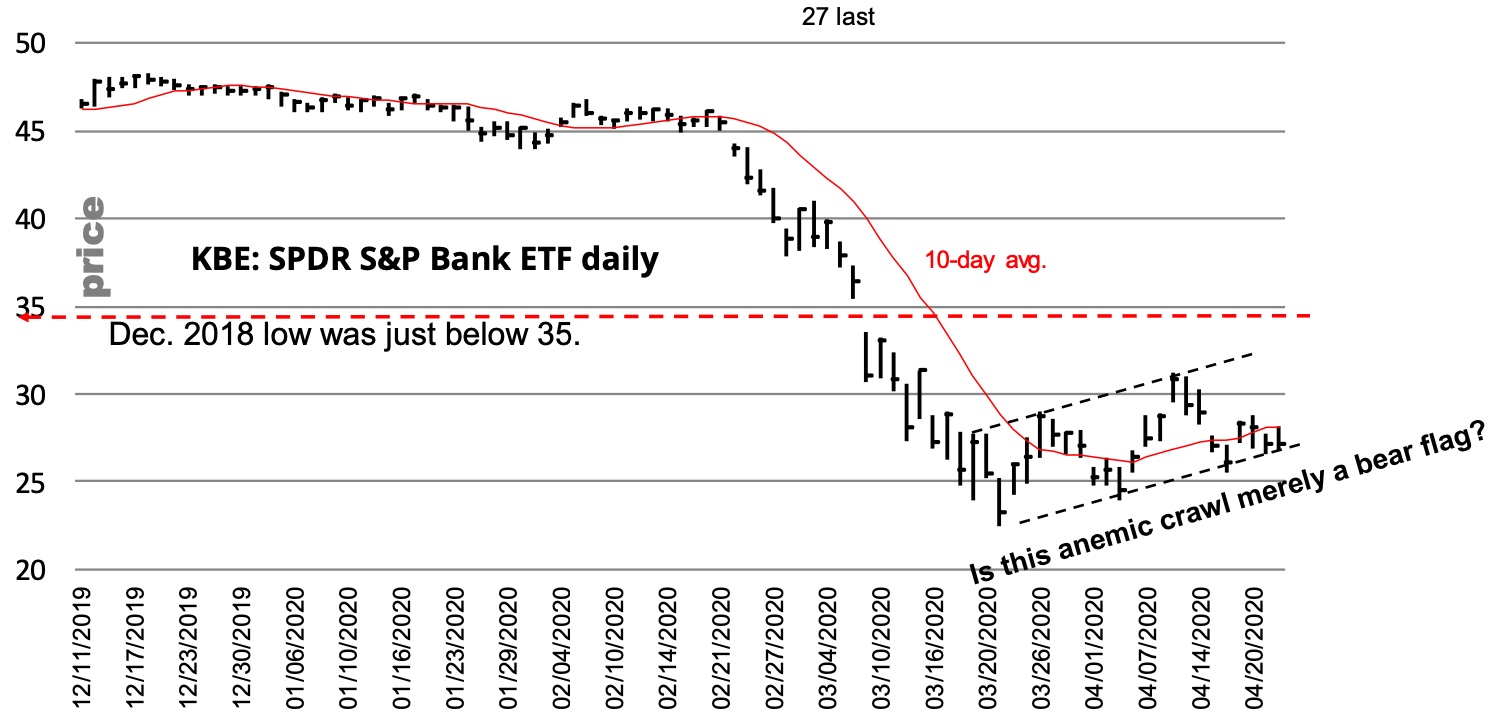
MSA continues to watch this sector with great interest. While the S&P 500 has taken out its December 2018 low and rallied back above it, banks have gone lame well below that prior major low (while some major European banks have taken out their 2009 financial crisis lows).


We suggest that the advance in gold has long had fundamental rationale based on the central bank- manufactured underpinnings of the stock market advance, especially since 2011. A skyscraper that was built not of concrete and steel, but plywood and plaster. Now undone, especially in various major sectors: banks, autos, energy, etc. And with massive renewed monetary response by CBs. Fuel for gold.

There is the potential that what just happened to oil (absence of bids) could happen in reverse to gold — an absence of offers! Such a technical event would not surprise us. And if it occurs it will probably be associated with an ambush-type news story. 

Perhaps one that comes from European or U.S. bank sectors. We shall see. This is a thought based on technical and fundamental factors.

- Source, Michael Oliver via King World News

Wednesday, April 22, 2020

This Global Collapse Is Like 100 Black Swans All At Once

Today legend Pierre Lassonde told King World News that this global collapse is like 100 black swans all at once.

Pierre Lassonde, legendary billionaire investor, philanthropist and company builder: “Eric, it is quite unbelievable what’s happening. Think of the world we live in with negative interest rates, the Coronavirus and the lockdown of America and other countries, and trillions of dollars being printed. It’s not like one black swan, it’s like 100 of them all at once.

Think about the oil business being completely devastated, and when you add the coronavirus on top of that, there’s another black swan. And with negative interest rates, where are retirees going to get their income from? I’ve been on this earth for 73 years and I’ve never seen anything like this before. But that is what black swans are all about. It’s not that they are unpredictable, they are out there, but when they show up that is when you can finally see the enormous damage they cause.

I think the market is way too optimistic in terms of getting out of this. The damage being done to small- and medium-sized businesses, which accounts for 70-75% of all jobs, is devastating and they are going to suffer the most. Eric, I have talked to people in the airline industry and they can see thousands of planes parked. The problem is that the plane is the tip of the iceberg of the entire economy. If the planes are not flying, there are no hotels booked, so there are no cars being rented, there are no restaurant reservations, and on and on, and you are not going to put 4,000 planes back up in the air tomorrow morning. Are you really that anxious to get on a plane with a bunch of people and breathe the same air for 8 hours? This will ripple through the whole chain, and we still don’t have a solution to this issue…

Arts and culture is also being devastated, Eric. All of the revenues have collapsed to zero. So 200 people in one pocket doing live performances are gone. And those jobs may be gone forever. That’s what the economists are missing.

Job Losses Will Become Even More Devastating

And this war on Covid-19 will have a much more lasting impact. War is the mother of necessity and it speeds up the adoption of technology and the adoption of technology has been fierce, especially when you look at companies like Netflix. But these companies that have all of these jobs will look at their workforces and cut jobs because 20% of the people do 80% of the work. So job losses will become even more devastating. People have no idea how bad this depression is right now and what the future really holds.

Look at groceries being delivered. When this is over, will people go back to grocery stores? A great many will not. So this is changing the world. There is not a prayer in hell that things are going back to normal. The damage is so deep and will last way longer than anybody thinks. So then you start to think, well, what will people do this summer? They have already been laid off for a month of two, so will they take a holiday? Probably not. So restaurants cannot survive this. Can they survive without customers for a year?

- Source, King World News, read more here

OIL ARMAGEDDON: What Will It Mean?


Today, the world changed. Join Mike Maloney for this Special Report as he explains what ‘Oil Armageddon’ means for the world, your country, your family and your future. Buckle up.

- Source, Mike Maloney

Monday, April 20, 2020

Silver and COVID-19, Capitalism's Black Swan

Over the past few weeks and months, there have been seismic changes in the way people are thinking of markets – and the concept of markets – generally.

As evidenced by movements in the Federal Reserve’s sale and repurchase facility from last September, which has resulted in the TARP balance sheet reaching a record of $6,000bn and at a record rate of over $630bn/month since the year began, there are ‘issues’ with all markets – in as much as markets are markets with ‘monetary’ fiat.

The whole concept of ‘owning shares’ is being questioned by those who’ve been taught to remain braindead by generations and generations of ‘economics teachers.’ It’s in this context that metal futures – especially of gold and silver – are moving apart from other ‘securities.’ May silver returned a co-basis reading of +0.2% on 10th March 2020 – i.e. actionable backwardation – before falling to its current level –12.3%. This would ordinarily indicate a substantial move out of silver – and indeed silver’s ‘fiat price’ fell from $17/oz on 10th March to $12 by 19th March. It should be noted that over the same period, the Dow Jones Industrial average fell from 25,001 to 20,087 – ‘value’ never to be recovered, allowing for ebbs and flows. =

Is there a true ‘reduction in demand’ for silver? Those who hold ‘securities’ are trying to switch from those that will vanish (‘shares’ and ‘bonds’) into ones that will not vanish, or at least ‘one side of which’ won’t vanish – and silver/gold futures/forwards, amongst other goods, fit that requirement. This is evidenced by looking at changes in COMEX system of repositories’ inventory, which gives a clearer picture as to the true ‘demand for silver.’


When registered silver declines in conjunction with silver being brought into the COMEX system, managers are worried about their maintenance of exchange between ‘futures’ and ‘physical.’ This can only be for ‘increased demand for silver of itself †.’ If this happens repeatedly then there’s ‘repeated demand for silver.’

Precisely such a situation is occurring in silver, as can be seen in the ‘COMEX silver stress indicator’ chart – which tallies such demand. It has remained elevated whilst May silver’s co-basis has fallen sharply. Demand for silver of itself is there and growing and will mimic interest in the automatic favourite of gold. The gold/silver ratio, currently at 111X, provides an excellent opportunity to switch from gold into silver...

- Source, Silver Bear Cafe

Sunday, April 19, 2020

Global Crisis Meets Macro and the Future of Cryptocurrencies


Raoul Pal joins Dan Morehead, CEO & founder of the cryptocurrency investment firm Pantera Capital, in a timely discussion about the current state of play in markets and the global macroeconomic outlook in the wake of coronavirus. 

While Morehead is one of the best-known names in the crypto investment space, he draws on the analytic toolkit he developed earlier in his career, as a macro trader at Tiger Management, the hedge fund run by investing legend Julian Robertson. 

Additionally, Raoul and Dan explore the opportunities in the digital asset space and discuss more broadly what they’ve learned in their decades as investors about the underlying essence of crisis and recovery.

- Source, Real Vision

Friday, April 17, 2020

What is the Future of the Fiat Dollar System and How Will Gold Respond?


Ronald-Peter Stöferle, a Chartered Market Technician and a Certified Financial Technician, gives his opinions on what is transpiring in the gold markets.

- Source, Jay Taylor Media

Monday, April 13, 2020

Retirements At Risk from Borrowed Bullion ETFs & Sucker Rallies


It's Not Too Late, if you ACT NOW... 


Nick Barisheff, author of "$10,000 Gold" and CEO of Bullion Management Group (BMG-Group.com,) returns to Liberty and Finance / Reluctant Preppers to report on his latest article warning us that the most popular gold and silver ETFs are built on borrowed bullion, and that extensive modeling of the 2008 market crash.

The Great Depression of 1929-1940 reveals that we are likely heading into a decades-long depression set to dash the retirement plans of most investors - unless they make a few critical moves now, while we're still in the twilight of a Fed-funded bear market sucker rally.

- Source, Reluctant Preppers