After a devastating supply-chain issue caused by the COVID-19 pandemic, normalcy is coming back to the gold and silver bullion market, according to Peter Hug, global trading director at Kitco Metals.
In an interview with Kitco News, Hug said that premiums for gold and silver are starting to fall back to pre-crisis levels; however, he added that supply is still an issue as many mints are still producing below capacity and providing coins on an allocation basis.
Fed critic and former advisor to the Federal Reserve of Dallas, author of “Fed Up - An Insider’s Take on Why the Federal Reserve if Bad for America,” Danielle DiMartino Booth, returns to Liberty and Finance in advance of her appearance as a keynote speaker at the 2020 Virtual Sprott Natural Resources Symposium, to discuss her upcoming conference address, and to answer provocative questions from viewers about the new greater depression, the double-bind of a banking crisis vs. a currency crisis, the gold standard, and the very existence of the Fed.
Thanks to Steve St. Angelo of the SRS Rocco Report, we found out exactly how much silver mine supply in Mexico and Peru came offline in February, March and April.
Tom welcomes Patrick Karim back to the show to discuss his latest charts on silver. Patrick is a proprietary capital manager and chart trader. Patrick is cautiously optimistic about precious metals and, in particular, silver.
He says, "We are at a deciding point, and we could go either higher or lower." The risks to the downside for silver are quite low since it has been so unloved.
We could have a nice move higher for silver once most of the weak hands have been shaken out. Patrick says, "It's likely go time for silver."
He discusses several charts on silver and the miners and why an explosive breakout is entirely possible.
He expects a bullish period and cautions investors to avoid listening too much to the echo chamber. It's essential to have tools and techniques to filter out the noise and make sound decisions.
He gives some suggestions for selling once we get a specific distance above the fifty-day moving average. He expects to see $31 by early next year, and then there is potential for higher prices into the $58 range.
Patrick thinks we may have already broken out of the long-term bear trend. Everything shows potential, and silver will move very quickly higher once we break above $19 to $20.
Old highs become new lows. Gold pushes above $1800 amid a tense economic climate. Silver has broken up on it's 5th attempt through a key level, will it press on to $20? Is platinum poised for a large upswing as well following gold? The US Dollar index sees continued weakness as it pushes further down.
Three time best-selling book author Nomi Prins says gold prices are going to “follow the expansion of the Fed’s balance sheet.” It is that simple, and Prins predicts, “As we saw in the wake of the financial crisis of 2008, gold and silver will have the ability to go up quite substantially as the Fed’s book increases in size, which we know it is going to do. We have been told that multiple times by many different words by Federal Reserve Chairman Jerome Powell.”
In closing, Prins says, “We are continuing to drive up asset bubbles where we don’t have the real economy to back it up. The more this ‘Permanent Distortion’ gets bigger, the more the likelihood the next crisis will happen . . . and it will be from a higher height. It will be from a larger bubble, a bigger snowball accelerating downward more quickly. I don’t think we are out of this crisis. I think the markets are going to have a bumpy ride as the economy has a bumpier ride.”
This July 4th, much of the United States finds itself under various levels of dictatorial orders from renegade governors, county, and local officials.
The US is under rule by decree, not by rule of law. Looking at the original list of grievances the Colonists had against King George, it looks like most of them are met - and then some - by our current system of government. Can we regain our independence?
Michigan State Economics Professor Mark Skidmore’s latest update to the “Missing Money” question is now the biggest in history by a long way.
Skidmore’s research reveals the US Treasury market is rolling over $90 trillion to support the official debt of $22 trillion (2019.) That’s on top of the $21 trillion Skidmore revealed in so-called “Missing Money” in late 2017.
Why do you need to churn $90 trillion in debt? Is the US debt really $90 trillion? What could go wrong with this much hidden debt? Skidmore says, “Yes it is concerning to me because this could blow up.
We don’t know when or how, but if people lose confidence in our government, they could lose confidence in the currency. That could have severe impacts on lots of people in the whole global economy above and beyond what we are experiencing now.
Is there some reset in play? Is there some bigger issue at stake? Is this pulling away with other goals in mind?
Yes, I think so. I don’t know how this all fits together but I do know there is something else going on that we all need to pay attention to.
I have documents that say something is really, really wrong, and it’s not just bad accounting.”
The great Frederic Bastiat said that "Trade barriers constitute isolation; isolation gives rise to hatred, hatred to war..." This is the path that should be avoided.
If America is unattractive to entrepreneurs, and is falling behind competitively because it is saddled with the biggest government on earth, perhaps the focus should be setting the American entrepreneur free from the bureaucracy.
For obvious reasons, American politicians do not want to decrease their power. They would much rather point the finger outwards.
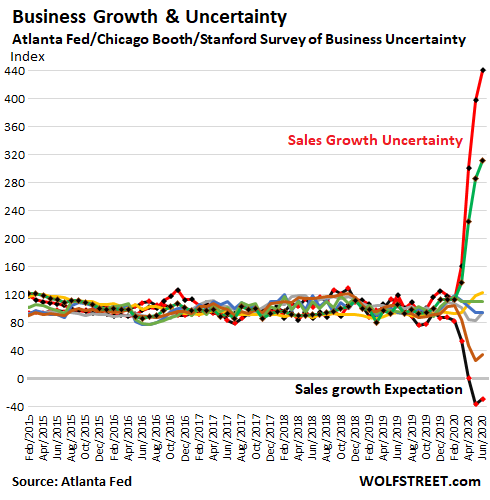
I’m going to show you a chart based on data that the Atlanta Fed released today. We’ll dissect it in a moment. The chart would be funny, if it weren’t so serious. At first, just look at the chart superficially. These results are based on surveys of businesses of a wide variety of sizes, spread across all sectors of the economy (except agriculture and government), in all regions of the US. They’re asked about their own businesses, in terms of sales, employment, and capital investment over the next 12 months. And the chart also shows how uncertain the participants are about their own expectations.
So this is about expectations for their own businesses, and about the uncertainty of their own expectations. For now, just look at the chart without analyzing it: It shows better than just about anything else what mess businesses face going forward: Their world has gone haywire.
The pandemic has hit businesses differently. Some businesses have reported booms in demand because of the shifts cause by the lockdowns and other factors, and they have trouble keeping up. Other businesses are in a state of collapse or have filed for bankruptcy. And then there’s every business in between. And these results are the averages of the pandemic’s winners and losers combined.
Expectations of Growth and the Uncertainty of those Expectations
There are two factors here in the Atlanta Fed/Chicago Booth/Stanford Survey of Business Uncertainty: These companies’ expectations; and their uncertainty about their own expectations. Business expectations.
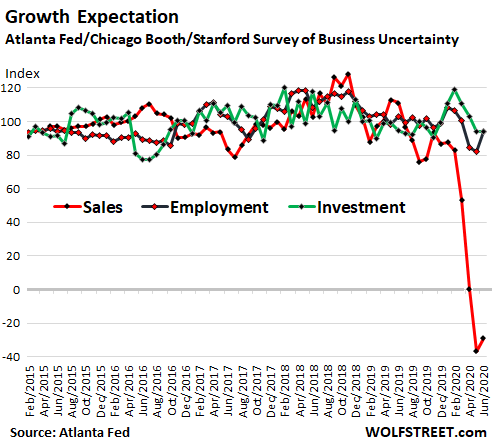
Expectations of sales growth over the next 12 months (red line in the chart below has been trending down since November 2018 (high of 128.5). This was later borne out by the slowing economy. Those expectations were already low before the pandemic hit in December 2019 (86.7), indicating a further slowdown of the economy for 2020, and remained roughly in that range in January and February.
The collapse of those expectations commenced in March (53.6), and carried through April (0) and May (-36.6). In June, they ticked up but remained terribly low (-28.9).
Expectations about growth for capital investment (green line) and employment (black line) over the next 12 months declined in March, April, and May, but didn’t collapse. And both ticked up in June.
Each of the indices captures the direction and magnitude of how these companies expect sales, employment, and capital investment to change over the next 12 months. The indices have been set with a mean of 100 from January 2015 through December 2018.
Uncertainty about of those expectations
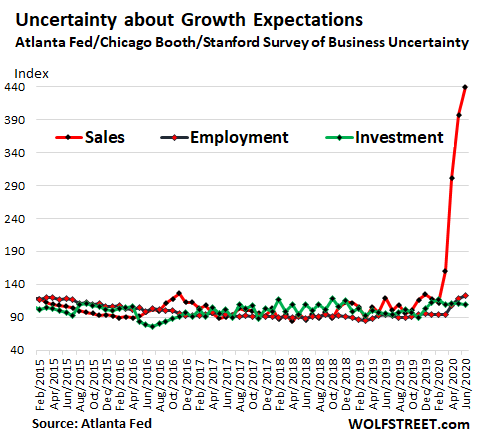
But businesses face a wall of uncertainty, and consequently, have become very uncertain about their own expectations – particularly about their expectations of sales growth. The uncertainty index tracks the gap between each company’s “lowest” and “highest” sales growth scenarios, or when the company assigns a higher probability to their “lowest” and “highest” case scenarios.
The uncertainty index for sales expectations (red line in the chart below) began spiking in March, but unlike sales expectations, the uncertainty about them continued to spike in June.
In comparison, the uncertainty about their employment expectations remained relatively low, but nevertheless ticked up in June the highest level in the data series. Uncertainty about investment remained range-bound:
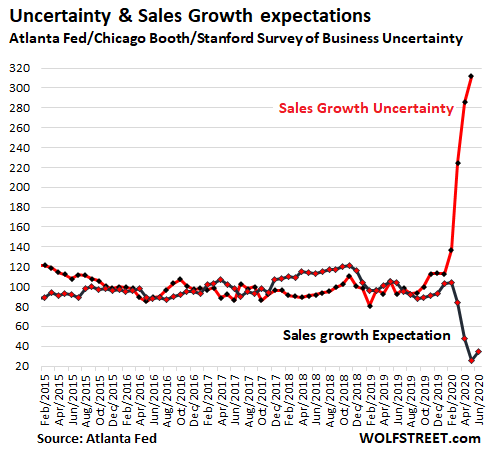
So, plotting on the same chart the businesses’ expectations of sales growth and their uncertainty about their own expectations of sales growth shows the environment that companies find themselves in. While expectations of sales growth for this coming year plunged, the businesses are totally uncertain about those expectations, and they assign high probabilities to both extreme scenarios – a strong recovery in their sales or continued misery in their sales.
What these businesses are saying is this: They took a big hit in sales and in June still expected those sales to remain at low levels for the next 12 months, but they have no visibility over those 12 months, and have no clue how this will turn out, and lack any kind of confidence in their own expectations of where sales might go.
Practically by definition, a business decision maker has to expect sales growth, and has to figure out how to make it happen. That’s part of the job.
But unless visibility increases and certainty about their own expectations increases, it’s going to be tough to plan and make long-term decisions with confidence. From a business point of view, this is a mess.
It has been a big week for the gold market as surging momentum has pushed prices to their highest level in nearly eight years.
In an interview with Kitco News, George Milling-Stanley, chief gold strategist at State Street Global Advisors, said that he continues to expect gold to push higher through the rest of the year.
Although his base case doesn’t call for $2,000 gold by year-end, he added that a move to that level is not out of the “realm of possibilities.”
Unprecedented monetary policy action will boost long-term inflationary pressures, supporting gold's long-term uptrend; however, one market strategist said that investors should keep their eye on economic uncertainty to push prices out of their month-long trading range.
In an interview with Kitco News, Kristina Hooper, global chief investment officer at Invesco, said that although some economic data have improved recently, the global economy is still far from recovering from the devastation it saw as a result of the COVID-19 pandemic. She added that the threat of a second wave of the virus will be another headwind for the recovery.
As we've been railing on for too long now, the Federal Reserve is NOT serving the interests and welfare of the general public. Instead it serves the top 1%.
Or more accurately, the top 0.1% -- i.e., the people who actually own the vast majority of financial assets, corporations and real estate.
Right now, the Fed is pouring gasoline on the "wealth gap"; the tremendous divide in social inequity it has largely been responsible for creating. And yet it's Chairman, Jerome Powell, flat out refuses to acknowledge this.
The very valid grievances of many dispossessed and disempowered groups can be laid at the feet of the Fed. Minorities starting at diminished employment prospects? Seniors unable to live off of their life savings in a world of 0% interest rates?
The Fed is either directly or indirectly responsible. It's way past time for society to realize the truth and stop believing the Fed's pitch that it's the hero riding to the rescue in this story.
It's not. It's the villain who created the injustices we're sick of. And it's "rescue" efforts are simply a trojan horse for using a crisis of its own making to enrich its stakeholders further...