buy gold and silver bullion

Wednesday, April 30, 2014

The Dark Side Of The Silver Mining Industry

There is an insidious Dark Side to the silver mining industry that goes unnoticed by the majority of investors and analysts. Actually, I haven’t come across one mining analyst who puts out comprehensive data on this very subject for the silver mining industry.

According to my figures for 2013, the top primary silver miners suffered the lowest average silver yield ever. That’s correct… another year of declining ore grades and yields.

Looking at the chart below, the top 6 primary silver miners average yield for 2013 was 7.6 ounce a tonne (oz/t) compared to the 8.1 oz/t recorded in 2012. Thus, the top miners shed another half ounce of silver yield… falling 6% in 2013.


The top primary silver miners average yield declined 41% from 13 oz/t in 2005, to 7.6 oz/t in 2013. The top 6 mines and companies included in the chart above are BHP Billiton’s Cannington mine, Fresnillo, Pan American Silver, Polymetal’s Dukat & Lunnoye mines, Hochschild and Hecla.

Four of the mines suffered year over year declines while two actually increased yields. Here is the breakdown:

Change in Yield (2012-2013)

BHP Cannington mine = - 1.0 oz/t

Fresnillo mine = -1.2 oz/t

Pan American Silver = -0.3 oz/t

Polymetal = +0.6 oz/t

Hochschild = -0.4 oz/t

Hecla = +1.0 oz/t

Both BHP Cannington and the Fresnillo mine will continue to see their average ore grades decline in the next few years, however Fresnillo’s silver grades should stabilize at 271 grams per tonne.

Hecla increased its average yield at its Greens Creek mine in Alaska by more than an ounce in 2013, which was the contributing factor pushing its average yield higher last year.

Declining ore grades are the Dark Side of the mining sector because the industry would rather not advertise its impact on the cost of producing silver. This next chart shows the increase in total processed ore since 2005.


Even though the average silver yield only declined 41% since 2005, the amount of processed ore increased 65% from 9.4 million tonnes in 2005 to 15.5 million tonnes in 2013. Not only has the amount of processed tonnage increased to produce less silver in 2013 compared to 2005… the costs of energy, labor and materials have doubled or tripled during the same time period.

The negative impact of falling ore grades can be seen using Fresnillo as a perfect example. Fresnillo Plc only had one primary silver mine prior to 2009 — it’s Fresnillo mine. Since then, it added another silver mine (Saucito) and several gold mines. The charts above present data from the Fresnillo mine only.

Adding Fresnillo Plc’s Saucito silver mine, which started production in 2009, this would be the net result on average yields for these two operations:


From 2005 to 2008, the Fresnillo mine accounted for total production in this chart. In 2009, Saucito came online which is shown by the ramp up in total production from 2009-2011. However, total mine supply started to decline in 2012 due to Fresnillo’s average yield and production falling sharply that year.

Even with production from both mines in 2013, the total was barely a million oz more than what the Fresnillo mine produced alone in 2005. Furthermore, it now takes the cost of running two mines to supply the same amount of silver in 2013 as the company did in 2005.

The table below shows the increase in workforce over a five-year time period from 2008 to 2013.


In 2008, Fresnillo had approximately 1,500 workers at its mine producing 33.8 million ounces of silver. I estimated the worker figure for 2008 as they offered no employee data in their 2008 Annual Report. According to their 2009 Annual Report there were 1,531 workers.

Now, if we look at the situation in 2013.. we see a much different picture. In 2013, the Fresnillo mine increased its workforce to 1,674 and Saucito had 999 for a total of 2,673. Thus, it now takes nearly 1,200 more workers to produce about the same silver in 2013 than it did in 2008.

Furthermore, the type of workers at Fresnillo have changed in the past five years. In 2008, the Fresnillo Mine had 894 employees and 637 contractors working at the project. By 2013, the number of employees grew 13 to 907, while its contractors increased 130 to a total of 767.

Moreover, the Saucito mine has no company employees whatsoever… the 999 workers are all contractors. So, the amount of contractors working at these two mines are nearly double (1,766), compared to 907 company employees.

This is the new way of the mining industry…. utilizing contractors so the company isn’t responsible for providing any healthcare or retirement benefits. You see, the mining companies are forced to make these kind of changes to keep costs from getting out of control.

Using Fresnillo as an example, the company added 1,200 more workers since 2009 to maintain silver production at the same level. In 2008, Fresnillo produced an average of 23,200 oz of silver from each worker, but by 2013 this figure fell to 12,832… nearly half.

Falling ore grades and yields are impacting all mining companies. It will become more expensive to produce silver in the future as ore grades continue to decline while costs of energy, materials and labor increase.

For those analysts who believe the price of silver is heading lower in the future… the falling yields and increased costs will prove otherwise.

- Source, SRSrocco Report:


Monday, April 28, 2014

The Decline In Shanghai Silver Stocks Picks Up Speed

Someone is taking delivery of silver from the Shanghai Futures Exchange in a big way. The amount of silver withdrawn from the exchange increased substantially this week. Matter-a-fact, more silver was removed this week than in the past three weeks combined.

Earlier this week, I posted a chart on the change in silver warehouse stocks at the Shanghai Futures Exchange. In less than two months, silver inventories at the exchange declined 244 metric tons.

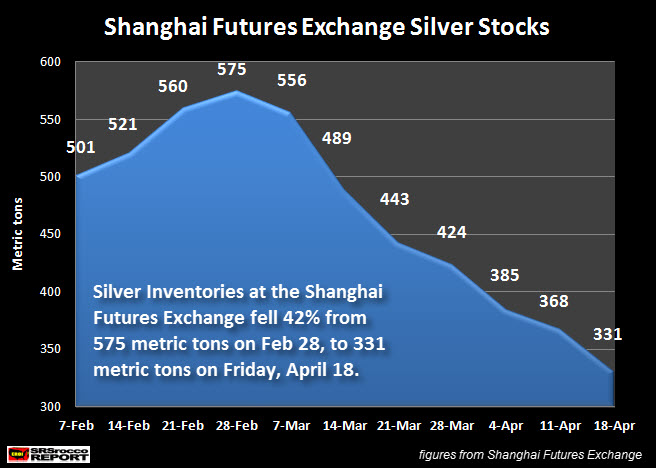
Here is the chart from my prior article:


As we can see the silver inventories declined from 575 metric tons (mt) at the end of February, to a low of 331 on April 18th. This was a 42% decline in seven weeks.

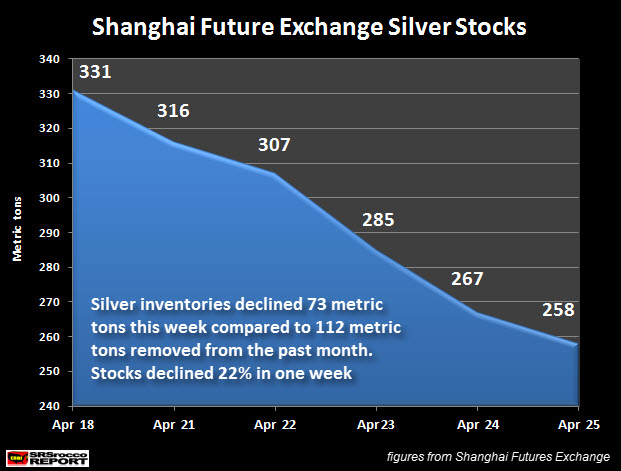
According to the most recent data put out by the Shanghai Futures Exchange, silver withdrawals picked up significantly this week. There were 15 mt removed on Monday, 9 mt on Tuesday, 22 mt on Wednesday, 18 mt on Thursday and 9 mt on Friday.


Since my last update, total silver inventories at the Shanghai Futures Exchange fell 73 mt, from 331 mt on April 18th to 258 mt this Friday, April 25th. In less than two months, 317 mt of silver or 55% of total inventories were removed from the exchange.

Furthermore, the Comex shed another 1 million ounces of silver today:


Over the past two months, gold inventories at the Comex have risen slowly, while silver warehouse stocks continue to decline. A total of 17.2 million ounces of silver were removed from the Shanghai (10.2 million oz) and Comex (7 million oz) exchanges since the end of February.

For some reason, a great deal more silver is being withdrawn from the Shanghai Futures Exchange. In just one year, inventories at the exchange declined from 1,123 mt to current level of 258 mt.

It will be interesting to see how things unfold in the next several weeks at the Shanghai Exchange. If the current high rate of silver withdrawals continues.. there won’t be much silver left at the exchange at the end of next month.

- Source, SRSrocco Report:


Monday, April 21, 2014

10 Warning Signs Of A Stock Market Crash


Stock Markets are at a record high but Questor editor, John Ficenec warns there are signs that we could be in for a crash. Here are his top ten warning signs that a market crash may be imminent.

Friday, April 18, 2014

Shiller - Signs Of Weakening In Housing


Robert Shiller, Yale University economics professor, shares his thoughts on the pulse of the housing recovery. The components are showing weakness right now, says Shiller.

- Source, CNBC

Wednesday, April 16, 2014

Marc Faber - Market Crash Will Be Worse Than 1987


Marc Faber says the stock market is setting up for a decline more painful than the sudden crash of 1987.

"I think it's very likely that we're seeing, in the next 12 months, an '87-type of crash," Faber said with a devious chuckle on Thursday's episode of "Futures Now." "And I suspect it will be even worse."

Faber, the editor and publisher of the Gloom, Boom & Doom Report, has recently called for growth stocks to decline. And he says the pain in the Internet and biotech sectors is just getting started.

"I think there are some groups of stocks that are highly vulnerable because they're in cuckoo land in terms of valuations," Faber said. "They have no earnings. They're valued at price-to-sales. And this is not a good metric in the long run."

To be sure, there are prominent investors that disagree with Faber, among them legendary stockpicker Bill Miller, who said this week that conditions for a bad market simply don't exist.

But it's not just momentum stocks that Faber is wary of. He says that investors are coming to a stark realization.

"I believe that the market is slowly waking up to the fact that the Federal Reserve is a clueless organization," Faber said. "They have no idea what they're doing. And so the confidence level of investors is diminishing, in my view."

As investors adjust to this fact, and valuations shrink, he predicts a massive decline in the market.

"This year, for sure—maybe from a higher diving board—the S&P will drop 20 percent," Faber said, adding: "I think, rather, 30 percent. Who knows. But all I'm saying is that it's not a very good time, right now, to buy stocks."

Previously, in August 2013, Faber predicted that a 1987-style crash was coming. The S&P 500 is about 9 percent higher since he made that call.


—By CNBC's Alex Rosenberg

Monday, April 14, 2014

Russia, China Aim to Finish Gas Talks Before Putin’s May Visit

MOSCOW (Reuters) – Russia and China aim to wrap up a 10-year series of talks about Russian gas supplies before President Vladimir Putin visits China in May, media quoted the deputy prime minister as saying on Monday.

The Russian deputy premier, Arkady Dvorkovich, also said China is interested in alternative energy projects on the Black Sea peninsula of Crimea, annexed by Russia from Ukraine in March.

Moscow and Beijing have been involved in painstaking talks about possible Russian gas supplies to China, with price being the main obstacle to a deal.

"The gas talks are wrapping up. There is a common intention to complete this work before the Russian president’s visit to China in May this year," Interfax news agency quoted Dvorkovich as saying in a meeting with Prime Minister Dmitry Medvedev.

Last week, Dvorkovich went to China as part of a Russian delegation to discuss cooperation in the energy sector.

More…

Thursday, April 10, 2014

IRS Bitcoin Ruling May Have a Bright Side

Last week’s guidance from the IRS on tax treatment for bitcoin transactions may have temporarily impeded one avenue in a single jurisdiction, but it has opened up another more significant avenue.

An IRS “property” classification for bitcoin reaffirms it’s status as “digital gold” because it tacitly encourages one type of monetary activity (store of value) over another (medium of exchange).

If bitcoin is digital gold, then gold is analog bitcoin. Both commodities have a significant economic role to play going forward because one is a consensual store of value based on chemical properties and the other is a consensual store of value based on mathematical properties.

This ruling was a lose-lose scenario for the IRS because an alternative tax ruling for treating bitcoin as a currency would have placed it in direct transactional competition with the US dollar. The Department of the Treasury was loath to do that at least from a tax perspective.

- Source, CoinDesk, read more here:


Tuesday, April 8, 2014

How Israel Can, and Should, Become Ground Zero for Bitcoin

Michael Eisenberg is a partner at early-stage venture capital fund Aleph. A key figure in Internet and software investing in Israel, he currently resides in Jerusalem and lectures on entrepreneurship at Hebrew University.

Here, he makes a case for Israel as a potential hub for digital currency innovation.


This week, the US Internal Revenue Service (IRS) handed Israel a golden opportunity on a silver platter. Or, shall I say, a virtual gold opportunity. By deciding to tax bitcoin as an asset, like gold, the US Government effectively doomed bitcoin as a currency.

As Robinson Meyer correctly writes in The Atlantic:


“To tax bitcoin as property destroys its fungibility: one bitcoin can no longer be exchanged for anotherThis was one of the original intents behind the service. Bitcoin aimed to function as a kind of digital money, meaning it had to work as a unit of account, a medium of exchange, and a store of value.”

To be clear, this does not doom bitcoin. The protocol and architecture of the block chain-based ledger will still enable endless disruption of existing industries.

However, it does cripple some of the nascent US-based entrepreneurial efforts to boost bitcoin-based commerce until the currency abstraction layer arrives on top of the bitcoin block chain...

- Source, CoinDesk, Read More Here:


Sunday, April 6, 2014

PBOC Officials Discuss Bitcoin as China’s Central Bank Stays Silent on Rumours

Following as-yet-unconfirmed rumors that the People’s Bank of China would move to block domestic banks from working with digital currency exchanges this April, the price of bitcoin has declined substantially since 26th March, dropping from a high of just over $580 to today’s low of $442 on the CoinDesk USD Bitcoin Price Index.

The decline has been exacerbated by the fact the People’s Bank of China (PBOC), the country’s central bank, has not yet issued a formal response. Notably, this lack of action sharply contrasts the events of 21st March, when the PBOC reacted quickly to quash rumours it would ban bitcoin.

As of press time on 31st March, no official word had yet been given as to whether the PBOC’s stance toward bitcoin exchanges has altered.

However, two PBOC officials had independently addressed bitcoin, one via his personal microblogging site and the other at a speaking engagement at last Friday’s 2014 China Internet Conference.

The officials offered seemingly contrasting takes on bitcoin and other digital currencies – with the former advising Chinese citizens to “cherish life, walk away from bitcoin”, according to The Wall Street Journal, and the latter suggesting that bitcoin was a novel currency.

Though the statements may not reflect attitudes at the PBOC, they provide an insight into how the issue is perhaps being discussed at the major financial organization.

- Source, Coin Desk:


Friday, April 4, 2014

Silver Eagle Sales Hit New Record In March

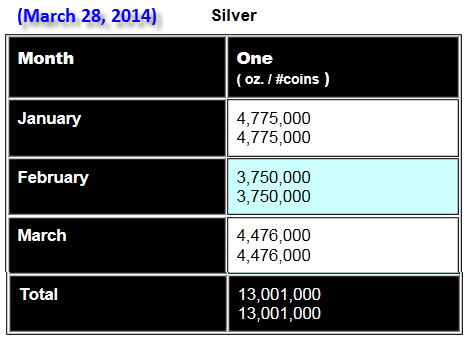
According to the recent update by the U.S. Mint, Silver Eagle sales hit a new record in March. Sales of the U.S. Silver Eagle reached 4,476,000 at the end of the week. Even though this surpassed the amount sold last year by over one million, the U.S. mint still has one final update to take place on Monday, March 31st.


If sales of the Silver Eagle top 500,000 on the last reporting day, total sales in March could surpass 5 million and overtake January as the highest monthly amount.

This would put total sales for 2014 at 13.5 million down compared to the same period last year which reached 14.2 million. While this is a decline year over year, it was more due to allocated limits rather than a fall in demand.

The U.S. Mint didn’t begin selling the 2014′s until the end of the second week in January. Furthermore, the Authorized Dealers purchased every allocated Silver Eagle they could for the month. Which means they couldn’t acquire any more than the 4,775,000 shown in the table.

Even with this limitation, sales in 2014 are doing quite well as purchases in February and March were stronger than last year. Here are the comparisons:

FEB 2013 = 3,368,500

FEB 2014 = 3,750,000

MARCH 2013 = 3,356,500

MARCH 2014 = 4,476,000 (current)

Without including Monday’s update, 2014 Feb & Mar are up 1.5 million compared to 2013.

According to the U.S. Mint, total allocated Silver Eagles for this week were 1,416,500 which would have brought the total for the month to 4.7 million. This week, only 1,192,500 Silver Eagles were sold… which suggests the total allotment was not purchased be the Authorized Dealers.

It will be interesting to see how many Silver Eagles are sold this coming Monday and if demand remains strong in April.

- Source, SRS Rocco:

http://srsroccoreport.com/silver-ealge-sale-hit-new-record-in-march-large-friday-comex-silver-withdrawal/silver-ealge-sale-hit-new-record-in-march-large-friday-comex-silver-withdrawal/

Wednesday, April 2, 2014

How the Rothschild Backed Fed Changed Real Money info Fiat

A man goes into a bank, prior to 1933, and hands over a $100 US Treasury Note, or even a Federal Reserve Note, which also was specie-backed, at the time, and asks for $50 in gold and $50 in silver. No problem.

Sometime after 1933, a man goes into a bank with a $100 Federal Reserve Note and asks for $50 in gold and $50 in silver.

Banker: “Sorry, sir. There is no gold or silver backing for your $100. Would you like two $50 Federal Reserve Notes, instead?”

What happened?

When the Federal Reserve Act was passed, two days before Christmas in 1913, when most politicians were home on holiday, the Act was passed with no opposition by the remaining chosen politicians who stayed on, and were well paid to do so by the Rothschild-backed bankers. And so the most treasonous act against the Constitution was passed.

- Read more here:


Monday, March 31, 2014

There is No Shortage of Gold, Shortage Developing is a Shortage of Trust!

Gold is a physical commodity. Its owners are removing it from the tradable markets, squirreling it away in nooks and crannies where they feel it’s safe. This is not merely a phenomenon of differing interest rates. Real metal is being moved in the real world, and everyone would do well to understand why, and what it means.
Trust is collapsing, and for good reason. 

The foundation of the global financial system is the US Treasury bond. It is backed by nothing more nor less than the full faith and credit of a government with exponentially rising debt, and which has neither the means nor intent to repay. If you don’t trust that the US government can pay, then you can’t trust a bank deposit because the bank uses the Treasury as their asset. If you can’t trust a bank, then you can’t trust a gold futures contract.

It is in this light that one must view gold backwardation. In wheat or any other ordinary commodity, there is sometimes a state of shortage. When that occurs, anyone with the commodity can make a risk-free profit by decarrying it.

However, there is no such thing as a shortage of gold. There is a shortage developing—a shortage of trust. Decarrying gold does incur a risk. One may be giving up good metal for bad paper, and never be able to reverse the swap.

Unfortunately, with the collapse of trust comes the collapse of coordination of economic activity. The disappearance of gold from the monetary system will have momentous consequences.

- Source, Silver Doctors:


Monday, March 17, 2014

Jim Sinclair: Russia Can Collapse US Economy, Gold Update, Silver is Gold on Steroids & More


Gold expert Jim Sinclair is issuing a warning of a massive downside risk to U.S. sanctions against Russia. Sinclair says watch the "struggling dollar" and Russia accepting any currency for oil and natural gas. Sinclair explains, "It's struggling . . . because it smells the real teeth of retaliation for sanctions being in the simple acceptance of any currency whatsoever for payment for gas to Europe. Believe me, they will settle in other currencies. . . . It makes energy cheaper. Why in the world would anyone want to pay in dollars if they can pay in their own currency? Russia could retaliate in a way that would have phenomenal impact on the U.S. dollar. . . . Russia has the upper hand. They have it in their ability to turn the U.S. economy upside down and into collapse. There is no question whatsoever. Putin doesn't need a nuclear bomb. He has a nuclear economic bomb that he can set off at any time."

What would the price of gold be this year? Sinclair predicts, "Gold has $2,000 an ounce in its sites in 2014." On silver, Sinclair says, "Silver is gold on steroids. When gold takes off, silver goes up faster. . . . So, the idea you are going to get an old high on silver or better is a given."

- Source USA Watchdog:


Tuesday, March 11, 2014

Want to Know What's in Fort Knox? Heres the Bar List

We have discovered the US’ official bar list of “Deep Storage Gold” held at Fort Knox, Denver, and West Point, buried in a PDF file on the House Financial Services website.
Updated on Sept 30th, 2010, the document provides a full bar inventory including total bars, weights, and fineness of the US Deep Storage Gold reserves.

For all those inquiring minds wondering how much if any of the US’ gold reserve remains, the official US Deep Storage Gold bar list is below:


- Source, Silver Doctors:


Sunday, March 9, 2014

Japanese Government Says Bitcoin Not a Currency, Forms Investigation Committee

Japan’s ruling party, the Liberal Democratic Party (LDP) has launched an investigative committee into bitcoin, and issued a statement saying it is “not a currency, but taxable”.

In what has become a familiar refrain from authorities around the world in recent months, the government has also blocked related banks from “brokering bitcoin transactions or opening accounts holding the virtual unit”. Exactly what constitutes a ‘bitcoin account’ remains unknown, but it presumably refers to one with a known bitcoin service like Blockchain.info or Coinbase.

This is likely a reaction to the international attention Japan has received after the collapse of Mt. Gox, which had its headquarters in Tokyo. Despite its hand being forced to make a statement by the Mt. Gox crisis, the Japanese government is generally curious about bitcoin and will not make any further statements on the matter until it has discussed matters with local bitcoin interests, a government representative said.

Representatives of the recently-formed Japan Digital Money Association, an advocacy group founded by Japanese bitcoin users and cryptocurrency miners, also consulted with LDP members with lawyers on Friday to present their case.
Obligatory statement

Bitcoin “does not fall under the category of a currency” as defined by Japanese law, Friday morning’s statement noted.
“Generally speaking it is subject to taxation if it meets conditions laid out in income tax law, corporate tax law and sales tax law, among others.”

Adding that there were no Japanese laws defining bitcoin, the statement concluded that if bitcoin was used for money laundering, ”that would constitute a crime”.

“As a matter of common sense, if there are transactions and subsequent gains, it is natural… for the finance ministry to consider how it can impose taxes,” Chief Cabinet Secretary Yoshihide Suga said.

- Source, CoinDesk, read the full article here: